
I gave the latest version of my Designing for Play talk at the @media conference (now run by the amazing John Allsopp / Maxine Sherrin team famed for their other fantastic Web Directions events) in London two weeks ago and was very pleased with the comments and feedback I got.
The sage Scott Berkun even gave me a pat on the back, as well as some useful constructive criticism (I was saying “um” a lot, as the audio will no doubt reveal – this is something I’ve worked on eliminating but I think in this case it was a “tell” that I am still feeling my way through this train of thought.)
Wow, WebVisions was amazing, as was Portland, and the hospitality of my friends there and the organizers of the conference. Thanks to everyone who made it possible! (I mean, Ukepalooza – say no more.)
Here are the slides from my talk, Designing for Play:
Arrived in Portland yesterday and did some prep for one of my gigs at WebVisions, the Ukepalooza set I’m playing with Bill DeRouchey as the duo “Cheeses & Tequila.”
…and even if the “visionary” thing is just a play on the name of the conference, well flattery will get you everywhere or at least it will get me to embed your video in my blog.
A week or so ago I undertook a whirlwind visit to the UK and the Continent, giving two presentations about design patterns and social design, one in London on Tuesday, and another in Berlin on Thursday, each event sponsored by YDN (and the one in Germany co-sponsored by the local IxDA group).
The London event was in a wonderful gallery/cafe venue called Wallacespace filled with a standing-room only crowd. I was pleased to see a couple of friends from the international UX community there and the audience as a whole was wonderful, attentive, and ready with interesting, challenging questions for me when I was done.
Afterward we ate some snacks and drank some beers courtesy of YDN, before heading over to a nearby pub for more beers and conversation. This was my first time back in London in fourteen years and I was impressed by the vibrancy of the web-design community in what may be the “capital” of the Web in Europe.
The next day I headed to Berlin, where a pal picked me up at the airport and helped me get settled in my hotel in Alexanderplatz. It’s actually been 20 years since I was in Berlin! Back then, the Wall had only recently been dismantled and the east was frozen in a sort of time capsule due to economic stagnation. A lot has happened since Berlin reunited and resumed its role as the capital of Germany and arts mecca of Mitteleuropa. In fact, there was a fashion convention going on during my visit, so the airport and hotel were full of people who made me feel, in comparison, more like a geek than a designer.
East Berlin is now full of trendy gentrified neighborhoods. I had lunch at a burrito place (!) called Dolores that’s decorated with maps of the Mission in San Francisco. Clearly the internet-savvy crowd in Berlin feels a kinship with our own community in the Bay Area.
Berlin is also the home of a thriving local Interaction Design Association (IxDA) group, which helped secure the venue for my talk–(Newthinking Store) and helped promote and publicize my talk. I had a chance to meet some longtime virtual acquaintances from the IxD and IA communities in Berlin, such as Jan Jursa, of IATV and the Berlin IA Cocktail Hour.
The Berlin talk was also full, and again I was blessed with a generous and attentive crowd. More great questions. (We did the whole evening in English. Try as I might to speak slowly, I still probably spoke a bit too fast at times but just about all the German I know is noch ein Bier, bitte so it’s just as well.)
One interesting difference between the two groups is that the folks in Berlin asked me more process questions: How was the social design project organized? How did the wiki figure into the writing of the book? What’s an unbook? and so on. The questions in London tended to be more about the efficacy of design patterns in general and the application of social design patterns.
At both sessions, certain attendees had reached out to me in advance over Twitter and proposed questions that they had a chance to ask at the events. In London and again in Berlin I was asked the perennial question about whether the use of design patterns stifles innovation. My traditional answer, “No. Now shut up and do your wireframes!” got a laugh in both settings as well. (My real answer: “Not if they are applied as guidelines and with sensitivity to context.”)
One other curious difference between the two events was that the audience in London had nearly perfect gender balance, whereas the one in Berlin was, by my estimate, about 90% male. I’d like to learn more about what the differences are between the web design and development communities in the two cities that might account for that variance.
I’d like to thank YDN for sponsoring the trip, and O’Reilly Media for providing logistical support (and some copies of the book to give away as rewards for great questions). Interested folks can see my slides on Slideshare:
This coming February 9 is approximately my one-year anniversary as co-chair of BayCHI’s monthly program and so far I’m enjoying the responsibility a great deal, even with the occasional panic that sets in when each new cycle rolls around.
As an aficionado of both music and games, I’m really looking forward to the analogies and lessons these two will share. Elaine is one of the founders of Meebo and she and I have had some really interesting conversations about the history and philosophy and pragmatics of digital product design.
Jeff is something of a famous wit, dating from his days writing the back-page humor column for Computer Gaming World (later Games for Windows Magazine), his various podcast escapades, his Greenspeak blog and of course on on the twitters. He has recently transitioned to a new role at EA, as editor-in-chief (and podcaster) for the EA.com website, and he may still be licking his wounds from his “if you’re so smart” encounter with the challenging realities and tradeoffs of interface design on a deadline.
Last week I was in Chicago for PLoP (Pattern Languages of Programs) 2009, co-located with the Agile conference. PLoP is a unique conference, in some ways more like a funky academic confab than a typical tech industry conference. Most of the time is spent in workshops, revising papers about patterns and reviewing small pattern collections. The rest of the time is spent debating fascinating philosophical questions and playing excellent ice-break games.
This year (my second PLoP) I presented an update on the social design patterns project geared towards people more familiar with the computer programming (aka “Gang of Four” or “Hillside”) design patterns, and then we workshopped chapter 3 of the book (the engagement design patterns).
This is the home page of Mediajunkie.com, the personal website of Christian Crumlish. We are in the midst of a re-design, please bear with us. Signed, the mgmt.
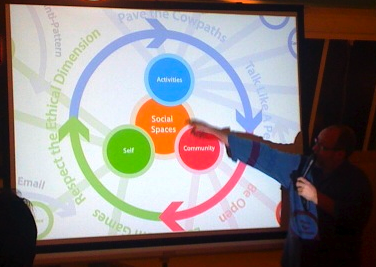
Overlap 09 (Near Future Laboratory), Julian Sanchez depicts some of our prototype pattern cards and a "why are you here" sketch I made on an index card